
MAS Holds its Sixth 2026 Roundtable Session on Gaza’s Recovery and Reconstruction Plans and Political Scenarios
Wednesday 19th Aug 2026
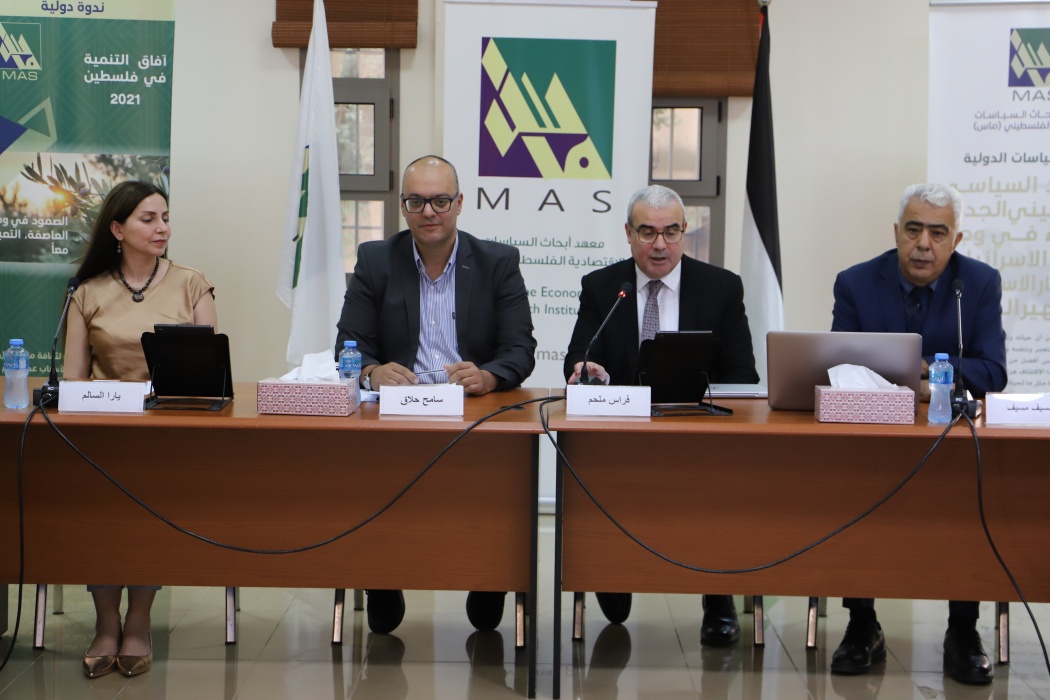
The Palestine Economic Policy Research Institute (MAS), in partnership with and with the sponsorship of the Heinrich Boell Foundation (Palestine and Jordan), held its sixth 2026 roundtable session to discuss “Postwar Gaza: Perspectives and A Comparative Analysis of Recovery and Reconstruction Plans and Political Scenarios”, at its premises and virtually. Researcher Misyef Jamil prepared and presented the background paper discussed in the session, while Dr. Omar Shaaban, Founder and Director of PalThink for Strategic Studies in the Gaza Strip; Ms. Yara Salem, Coordinator of the Technical Team for the Phoenix Gaza Initiative; and researcher Yasser Shalabi, commented on the paper.
In his opening remarks, the Director General of the Institute welcomed the participants and expressed his appreciation to the Heinrich Boell Foundation (Palestine and Jordan Office) for its support of the session.
Presenting the four sections of the paper, Misyef Jamil highlighted that the first section provides a comprehensive and detailed overview of the broader context in which these plans emerged. The plans are classified chronologically into three groups: plans issued before the latest war, plans developed during the war, and plans issued after the so-called ceasefire agreement of October 10, 2025. They are also categorized according to the entities that prepared them, namely international, regional, Palestinian, and private-sector actors. Building on this contextual overview, the second section presents an analytical matrix comparing the 14 plans against the criteria outlined above. The third section examines the international legal framework relevant to reconstruction, including international humanitarian law, the right to self-determination, and accountability for international crimes. The report concludes with observations that summarize its principal findings and the potential scenarios emerging from the analysis.
The researcher explained that the principal disagreement among these plans is not purely technical. At its core, it is political and concerns governance and sovereignty. The differences therefore center on several fundamental questions, such as: Who sets the priorities? Who controls implementation? Who owns the reconstructed assets? And will reconstruction strengthen Palestinian sovereignty, rights, and national ownership, or undermine them? Some plans treat Palestinians as aid recipients, a labor force, or beneficiaries within transitional international arrangements, while others grant them greater representation and participation in decision-making. Certain proposals also transfer decision-making authority to international actors, transitional bodies, or frameworks resembling international trusteeship. The assessment of any reconstruction plan should therefore extend beyond its technical quality or financial feasibility to include its implications for governance and its compatibility with Palestinian sovereignty and national rights. Taken together, the 14 plans reflect five principal approaches: the technical development approach, the political-security approach, the investment-driven privatization approach, the international transitional governance approach, and the participatory community-based approach.
Following this, the researcher presented four broad scenarios for possible reconstruction pathways that emerged from linking the findings of the preceding comparison to the political realities that may shape the “day after” phase, these are; Palestinian-led reconstruction under a regional and international framework, short-term international transitional governance, conditional private-sector-led investment, reconstruction under external security arrangements, and continuation of the status quo and fragmented, slow recovery under ongoing restrictions.
The first scenario, he argued, would strengthen local legitimacy and accountability, increase opportunities for Palestinian participation in implementation. Potential risks associated with this scenario include the politicization or delay of financing. The second scenario, nevertheless, could accelerate certain financing and implementation processes, yet its principal risk is the marginalization of the Palestinian role.
As for the investment scenario, it focuses on large-scale projects and partnerships with the private sector, yet risks weak social justice, threats to property rights, and entrenching long-term dependency. Conversely, continued restrictions and escalation would slow the reconstruction process, and interventions would be reduced to fragmented interventions, which would heighten social and economic risks. These scenarios underscore that the success of any plan depends not only on the quality of its design, but also on the extent to which it is aligned with the political and security realities and its ability to operate amid potential risks and constraints.
Misyef concluded his presentation with a package of recommendations centered on the need to redirect recovery and reconstruction plans toward a clear Palestinian reference framework grounded in national sovereignty and international law. He also called for the adoption of standardized criteria for assessing plans and distinguishing between forward-looking visions and implementation programs, while ensuring the protection of property and housing rights, reparations for damages, and the prevention of displacement. The researcher further stressed that reconstruction plans should be comprehensive, encompassing housing, infrastructure, the economy, health, education, social protection, governance, the environment, and community development, while strengthening local participation and the role of the Palestinian private sector.
To accelerate the reconstruction process, Jamil proposed the removal of restrictions hindering reconstruction, the achievement of national consensus and a unified political vision, and the mobilization of international financial and political support commensurate with the scale of destruction. He also highlighted the need to invigorate the role of local authorities, civil society, and the local economy, while ensuring that Palestinians are active participants and partners in the reconstruction process rather than mere beneficiaries. He further underscored the importance of coordinating the efforts of international institutions within a unified framework to reduce fragmentation and enhance the efficiency of financing and implementation, as well as the sustainability of the recovery and reconstruction process.
In her remarks, Yara Salem emphasized that the key differences among reconstruction plans are more political than technical. She highlighted that the presented paper compares 14 reconstruction plans and raises a critical question about who should own the reconstruction process in Gaza. Salem stressed that the ownership of the reconstruction effort must remain with the Palestinians. Additionally, she underlined the importance of prioritizing municipalities, as they play a crucial role in managing the reconstruction process and delivering essential services.
Salem further stressed that Gaza is not an uninhabited, empty land, and that destruction cannot erase memory or property rights. She added that reconstruction is an interconnected process that extends beyond rebuilding homes and infrastructure. Additionally, she called for initiatives to restore the Palestinian community’s capacity to rebuild and strengthen its resilience, as well as for integrating early recovery plans with reconstruction plans within a comprehensive vision.
In his remarks, Omar Shaaban highlighted that international attention towards reconstruction has diminished despite the ongoing war and daily bombings. He emphasized that some reconstruction plans were developed without any Palestinian participation. Shaaban stressed that discussions about reconstruction cannot be separated from the prevailing political and security realities, particularly given the ongoing restrictions on the entry of materials into the Gaza Strip and their subjection to Israeli approval. He also raised fundamental questions regarding who will finance the reconstruction process, as well as how supporting countries and entities will determine their priorities in light of other crises and competing demands. He highlighted the scale of suffering endured by Gaza’s residents as a result of the continuing killings and stressed the need for Palestinian unity in confronting a catastrophe that affects everyone. He also referred to the settler violence taking place in the West Bank.
Later, researcher Yasser Shalabi explained that the Palestinian government has prepared a reconstruction plan for the Gaza Strip, which was shared with the Egyptian side and subsequently endorsed by the League of Arab States. He also noted the existence of an early recovery plan. Shalabi emphasized that national ownership of the planning process is a fundamental element and that reconstruction planning should not be limited to technical considerations alone. Instead, it should be based on a clear political framework that incorporates these technical aspects. He further stressed that any regional or international initiatives must align with the Palestinian perspective, affirming that the official Palestinian approach should guide the planning and reconstruction process.
Participants agreed that early recovery should be the foundation of any reconstruction process in the Gaza Strip and that a unified national reference framework is needed to guide the various planning and reconstruction efforts. They also emphasized that the success of any plan remains closely linked to determining the future governance and administrative framework in the Strip. Furthermore, they stressed that the Palestinian plan should serve as the primary reference point for any regional or international reconstruction efforts, ensuring their alignment with national priorities and needs.