
Israeli Industrial Zones in the West Bank: An Economic Distortion Hindering Palestinian Development
Wednesday, May 20, 2026
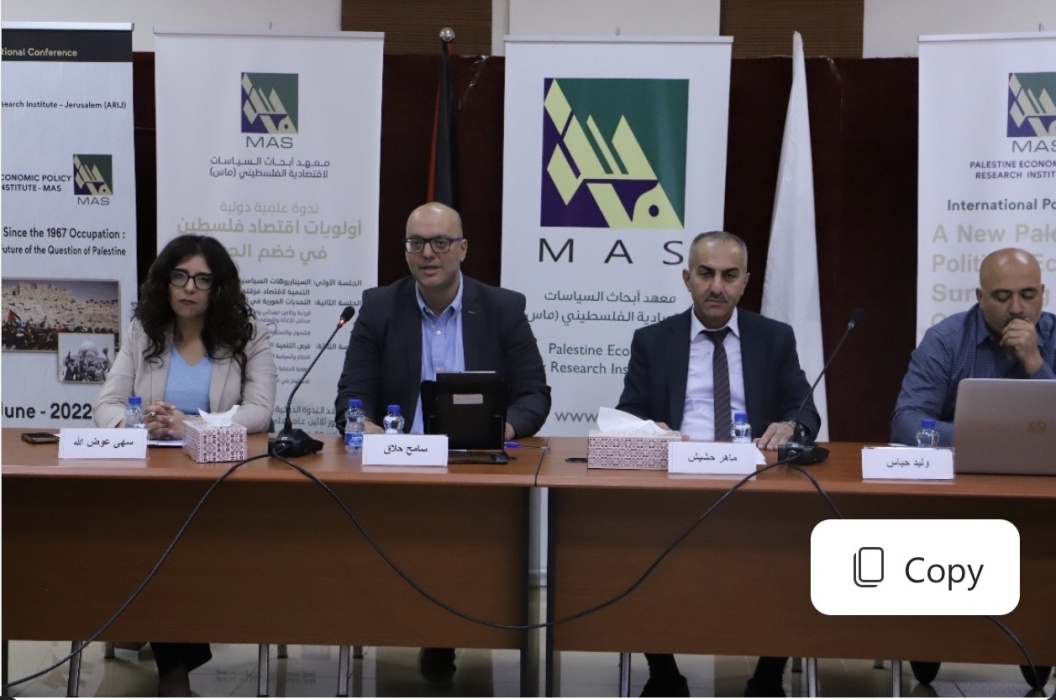
The Palestine Economic Policy Research Institute (MAS) held its second roundtable discussion of 2026 to examine “Economic Impacts of Israeli Industrial Zones in the West Bank: Palestinian Labor, Environmental Pollution, and the Disruption of Palestinian Logistics.” The session was held both in person at the institute’s premises and via Zoom. A background paper touching base on the discussion topic was prepared by Dr. Walid Habbas, researcher at the Palestinian Forum for Israeli Studies (Madar). Interventions and commentaries on the paper were presented by Dr. Maher Hashish, Advisor to the Minister of Industry, and Dr. Suha Awadallah, Secretary-General of the General Union of Palestinian Industries.
At the opening of the session, Dr. Sameh Hallaq, Research Coordinator at MAS, welcomed participants, including experts and representatives from various sectors. He stressed the importance of discussing this issue, highlighting the complex nature of Israeli industrial zones, which extend beyond a purely productive role to function as tools of economic control and resource redirection. He noted that this places direct pressure on Palestinian development opportunities and requires urgent attention. Finally, Hallaq expressed the Institute’s gratitude to the Heinrich Böll Foundation for its support of the Roundtable program.
During his presentation, Dr. Habbas provided a comprehensive analysis of the economic impact of Israeli industrial zones in the West Bank, framing them as part of an expansionist settlement structure that undermines the territorial contiguity of the West Bank and harms the Palestinian economy on multiple levels. He noted that there are approximately 35 industrial zones in the West Bank, including facilities for heavy industries such as metals, chemicals, plastics, and cement, in addition to industrial parks, technology parks, and commercial and service complexes. He explained that these zones contribute to strengthening economic ties between the settlements and Israel and are strategically connected to bypass roads and major transportation routes. Habbas explained that the paper identifies five main impacts on the Palestinian economy: First, these zones deepen Palestinian workers’ dependency through an unequal labor market characterized by low wages and legal vulnerability. Second, they attract Palestinian investments into these areas, reflecting a lack of oversight. Third, they disrupt trade due to the fragmentation and discontiguity of Palestinian territory, increasing transportation and commercial costs. Fourth, they intensify environmental pollution through the relocation of polluting industries to these zones, where regulatory oversight is weak. Fifth, they contribute to the confiscation of agricultural land and the degradation of natural resources, negatively affecting agricultural production and threatening food security.
Mr. Habbas concluded his presentation with a series of recommendations, including the adoption of a clear official Palestinian position regarding relations with Israeli industrial zones, addressing the factors driving Palestinian capital toward settlements, protecting Palestinian workers, and holding Israel accountable for environmental crimes. At the same time, the recommendations emphasized the importance of developing a long-term sovereign development approach that strengthens the Palestinian national economy and reduces economic dependence.
In his comments, Mr. Hashish emphasized that the Palestinian government places significant value on the studies produced by MAS. He pointed out that Israeli policies actively encourage settlement activity by offering incentives and facilities to industrial zones established in settlements, describing such investment as part of a settler-colonial project and an attempt to legitimize settlements.
Mr. Hashish further emphasized that the Palestinian government is placing strong priority on the development of industrial zones, given their critical role in enhancing economic resilience and generating employment opportunities. He noted that the Jenin Industrial City is expected to become operational in the near future and will serve as a pioneering cornerstone of the Palestinian economy, particularly with anticipated investment from Palestinian investors in the 1948 territories.
He added that the government mandates preference for Palestinian-made products in public tenders and is actively advancing renewable energy solutions within industrial zones to help reduce production costs.
For her part, Ms. Awadallah stated that the participation of some Palestinian investors and workers in Israeli industrial zones should not necessarily be interpreted as acceptance of the colonial project. Rather, she explained, it reflects the substantial gap between the restrictive Palestinian investment environment and the conditions offered by Israeli industrial zones, particularly in terms of infrastructure, stability, and access to markets.
There is an urgent need to establish a Palestinian economic alternative through the development of Palestinian industrial zones, improved infrastructure, reduced production costs, and stronger integration with Arab and regional markets, she emphasized. Any effective policy response must combine pressure with the creation of viable economic alternatives and employment opportunities. During the discussion, the participants emphasized the importance of highlighting the environmental damage caused by settlements’ industrial zones. They also stressed the need to measure the scale of Palestinian investment in these zones in the West Bank, as well as the extent of Palestinian economic presence within them.