
Prime Minister’s Office and MAS issue the Proceedings and Papers of the Palestinian National Population Conference
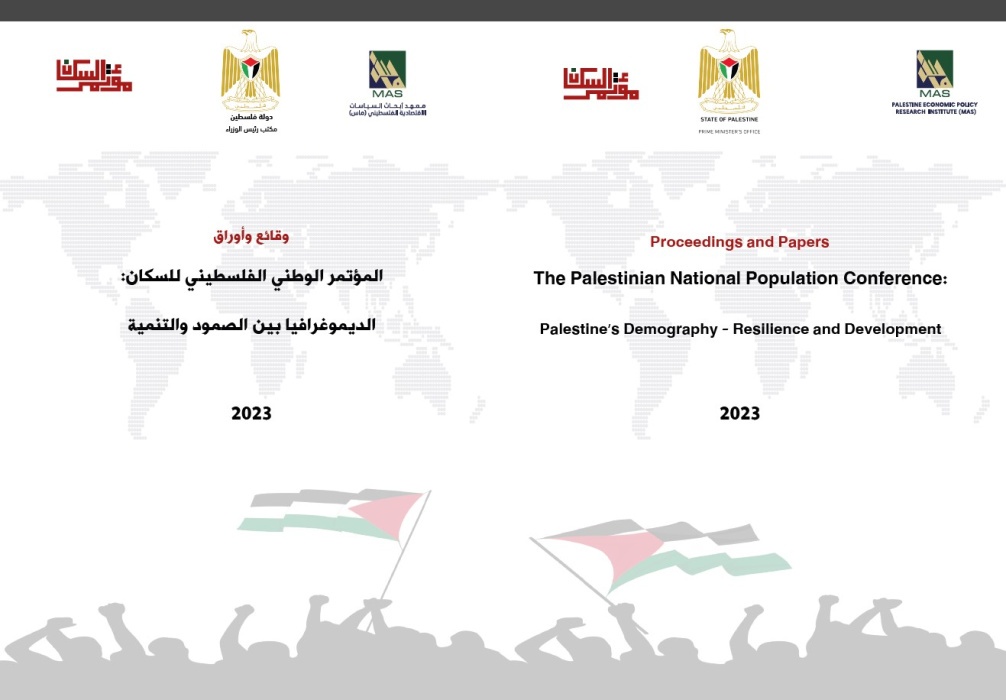
Ramallah, 26 March 2024: The Palestine Economic Policy Research Institute (MAS) has issued the book featuring the proceeding and papers of the “The Palestinian National Population Conference: Demography - Resilience and Development,” for both the Prime Minister’s Office and the National Population Committee. The book consists of two parts; the first section includes the conference proceedings and speakers’ intervention, comprising seven sessions that convened numerous experts, policymakers, and distinguished stakeholders across various sectors. These speakers participated in insightful discussions about forced and natural demographic transitions, and discussed the resulting economic and social repercussions.
The second section features the papers prepared for the conference, addressing seven distinct topics. The first papers delved into Current and Future Demographic Trends and Changes in the State of Palestine a Socio-economic Analysis, offering a ‘socioeconomic analysis’ showcasing that population is a very political issue within both the Palestinian and Israel contexts. The papers show opposite trends, a strong demographic shift among Palestinians on both sides of the Green Line, contrasting with a hesitant demographic shift on the Israel-Jewish side.
The second paper discusses the topic of Forced Demographic Change: Palestinian Population Resilience against Colonial Segregation and Displacement, which focuses on several special topic in regards to the Palestinian demographic challenge in the face of the Israeli doctrine, the spatial demographic transfer in Palestine, the varying spatial internation between the forces of colonial expulsion and the forces of Palestinian demographic resilience, as well as demographic projections for the year 2030, and adopting the doctrine of ‘maximum population in the widest possible areas.’
The third paper, titled “the Politics of Space in the Demographic Race Over Jerusalem,” provides brief history of the city of Jerusalem, building on theories of citizenship and politics of space within a settler colonial context. It explores the different methods of demographic manipulation which have contributed to transforming the Palestinian population of the city from a majority to a minority. To conclude, the paper presents tactics that can be developed by the Palestinian community and its leadership for the empowerment of the Palestinian residents to transform its demographic dividend to a developmental one for East Jerusalem.
The fourth paper explores Internal and External Palestinian Migration and its Developmental Challenges. this paper is divided into four main chapters, the first chapter presents a review of the most important literature on migration, its most prominent features and impacts, followed by an exploration of external emigration of Palestinians, and internal migration in Palestine. The last chapter outlines a set of proposed policies to mitigate challenges associated with immigration in Palestine, including the most important policies for addressing Palestinian overseas emigration, particularly in the category of scientific-minded and skilled workers.
The fifth paper titled “Social Protection and Demographic Changes in Palestine: Risks of Continuing Current Indicators” aimed to monitor the reality of social protection, in order to develop recommendations and appropriate policies in light of current and future population indicators. It provides a descriptive, analytical and statistical methodology, by reviewing Palestinian social protection programs and institutions, as well as gaps in social protection systems and mechanisms for distributing social protection assistance.
The sixth paper titled “Demographic Transitions as a Potential Catalyst for Higher Female Labor Force Participation,” investigates the causes of low female participation in the Palestinian labor market, and available means to increase this participation through both micro and macroeconomic policies. It also addresses structural gaps such as women’s unemployment and employment segmentation, where women are concentrated in specific sectors and income brackets
The seventh and final paper titled “Population Growth in Palestine and the Urgent Need to Promote Sexual and Reproductive Health for Women and Youth as part of the Sustainable Development Goals, focuses on an important pillar for national resilience, and thus, development. It focuses on health, with special focus on sexual and reproductive health and rights, with a particular emphasis on exploring the implications of demographic changes in the Palestinian community on health status and health services.