
MAS Discusses an Economic Recovery Framework and Sustainable Development to Strengthen Private Sector Resilience in the Gaza Strip
Thursday, October 29, 2026:
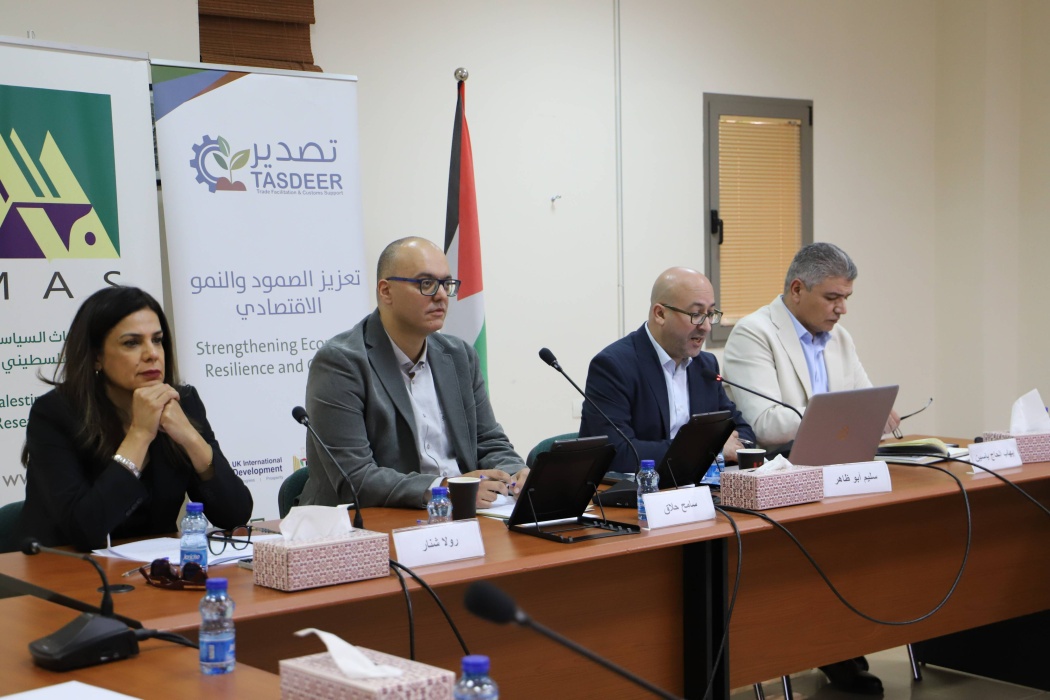
The Palestine Economic Policy Research Institute (MAS), in partnership with the Tasdeer programme, held a roundtable discussion entitled “Strengthening Private Sector Resilience in the Gaza Strip: An Integrated Framework for Economic Recovery and Sustainable Development”. The event took place at MAS’s Ramallah headquarters and online, bringing together specialists, experts, and other stakeholders. Dr. Salim Abuthaher prepared the background paper underpinning this discussion.
MAS’s Research Director, Dr. Sameh Hallaq, opened the roundtable by welcoming the participants and emphasizing the importance of strengthening Gaza’s private sector as an integral part of a broader recovery encompassing the entire Palestinian economy. He added that the roundtable enables dialogue among relevant stakeholders whose expertise can help guide the discussion and explore possible solutions. Ending his words, Hallaq thanked the organizations supporting the event.
Presenting a broader understanding of the private sector, Dr. Salim Abuthaher explained that it extends beyond private businesses to encompass commercial, industrial, and service establishments; small and medium-sized enterprises; and business owners, workers, suppliers, and contractors. It also includes the production, supply, financing, and marketing relationships that connect these actors. He emphasized that Gaza’s economic destruction did not begin from a position of stability: the blockade imposed since 2007 had already created structural constraints. The genocidal war then transformed those constraints into the widespread dismantling of the productive base, infrastructure, and markets. The result, he explained, is a “survival economy” where formal agricultural and industrial production is replaced by expanding informal activity and relief assistance, amid a worsening cash liquidity crisis.
In his paper, Abuthaher proposes a shift from an abstract concept of reconstruction focused on restoring physical assets to economic recovery focused on restoring economic functions and the production cycle in the Gaza Strip. This can be achieved by protecting and reactivating the remaining productive capacity alongside reconstruction, with priorities determined by the ability to resume actual production rather than the scale of damage sustained. Abuthaher outlined three interconnected stages as the most realistic approach toward that end: reactivating recoverable productive capacity within Gaza; reconnecting it with suppliers and markets across the Palestinian economy; and gradually expanding access to regional and international markets. The paper recommends regular monitoring of productive capacity; addressing operational bottlenecks; designing reconstruction procurement to enable Palestinian companies to participate; developing a phased financing approach; preserving human capital; designating a clear coordinating authority; as well as establishing a transparent economic information system; and linking recovery to urban planning.
Rula Shunnar, Chairwoman of the Palestine Exchange (PEX), commended the paper’s alignment with Gaza’s needs on the ground, particularly its emphasis on an integrated recovery framework that goes beyond reviving individual establishments. However, she identified Gaza’s current political context as hindering recovery implementation. She pointed to the absence of a clear political horizon and efforts to separate Gaza’s economy from that of the West Bank.
Shunnar affirmed that Palestinian companies, including publicly listed firms, are ready to invest and implement projects in Gaza across investment, industry, insurance, banking, healthcare, and education. However, conditions on the ground had not changed since the ceasefire last year, leaving little scope to begin. Ending her statement, she called for issuing bonds and sukuk and providing guarantees to companies to finance reconstruction, particularly in the absence of the necessary grant guarantees, an initiative PEX is currently working on, and stressed the need to narrow and focus priorities.
In his turn, Ihab Al-Haj Yassin, Director General of the Private Sector Development Unit at the Ministry of National Economy (MoNE), said that Gaza’s private sector had come under attack from the Israeli occupation and what he described as “suspicious entities” inside and outside Gaza seeking to sever its ties with the West Bank. He added that the Palestinian government and the ministry were working intensively to counter these efforts. Despite the emergence during the war of new entities seeking to deepen the political, social, and economic divide, the industrial federations and chambers of commerce continued to operate. He further noted that restrictions on the entry of trucks and goods were intended to concentrate private-sector activity in the hands of a limited number of Israeli companies and their partners in Gaza. Establishments with access to locally available inputs remained operational, he said, but faced severe shortages and sharp increases in the cost of fuel, production inputs, and energy.
Economic researcher and academic Dr. Sayf Al-Din Odeh, outlined fundamental constraints impeding the private sector’s ability to adapt, recover, and resume growth in the near future. At the forefront of these constraints is Israel’s continued occupation of approximately 65–70% of Gaza’s territory behind the “Yellow Line, which previously contained the majority of industrial zones and agricultural land reserves, alongside numerous other economic assets that have been completely destroyed and remain inaccessible. He also highlighted uncertainty over the private sector’s future regulatory and administrative environment under the Trump plan for Gaza; structural changes in Gaza’s economy, particularly the near-total shift to electronic payments; and severe restrictions under the coordination mechanism imposed by the occupation on the entry of goods. He said these restrictions had fostered monopolies, weakened competition, and driven unprecedented increases in costs and prices, sharply eroding citizens’ purchasing power and undermining the private sector’s capacity to resume production and operations.
Odeh stressed that recovery required dismantling monopolistic practices, lifting restrictions on supply chains, and restoring fair competition. He also emphasized the importance of appropriate financing channels and technical guidance for promising entrepreneurial initiatives capable of generating employment and income, including those using recycling to overcome shortages of production inputs. He called for timely action, with intervention priorities guided by scenarios that distinguish between early recovery and longer-term economic recovery. This would require a roadmap tailored to each phase and scenario, rather than waiting for complex political solutions amid Israeli extremism and obstacles imposed by the occupation government.
Also joining the roundtable via live broadcast from Gaza was Mohammad Skeyk, Director of the Gaza Programme at the Palestine Trade Center. He pointed to the near total destruction of the private sector in the Gaza Strip, arguing that the measures currently being taken to address the situation are doing more to mask the reality than to resolve it. He noted that the private sector is unable to sustain its operations without support in the form of inputs, energy, and equipment, particularly as most of the Gaza’s population continues to live in tents. He emphasized that identifying challenges and proposing solutions must consider the reality of the population’s displacement. Skeyk also stressed the paramount importance of considering mechanisms to address the political vacuum resulting from the division between the Gaza Strip and the West Bank.
In conclusion, several other participants underscored the severity of conditions in the Gaza Strip and the numerous challenges it faces, including the destruction of infrastructure, the lack or restricted availability of essential inputs, and rising energy costs. They noted that private-sector businesses and small enterprises are leaving Gaza due to the absence of stability and a clear vision for the Strip’s future. They stressed the need to prioritize strengthening the private sector’s resilience before moving to the recovery phase, given the collapse of conditions in Gaza and the sector’s inability to withstand the current situation without support across multiple areas.