
Education Sector Recovery in Gaza: Roundtable Discussion
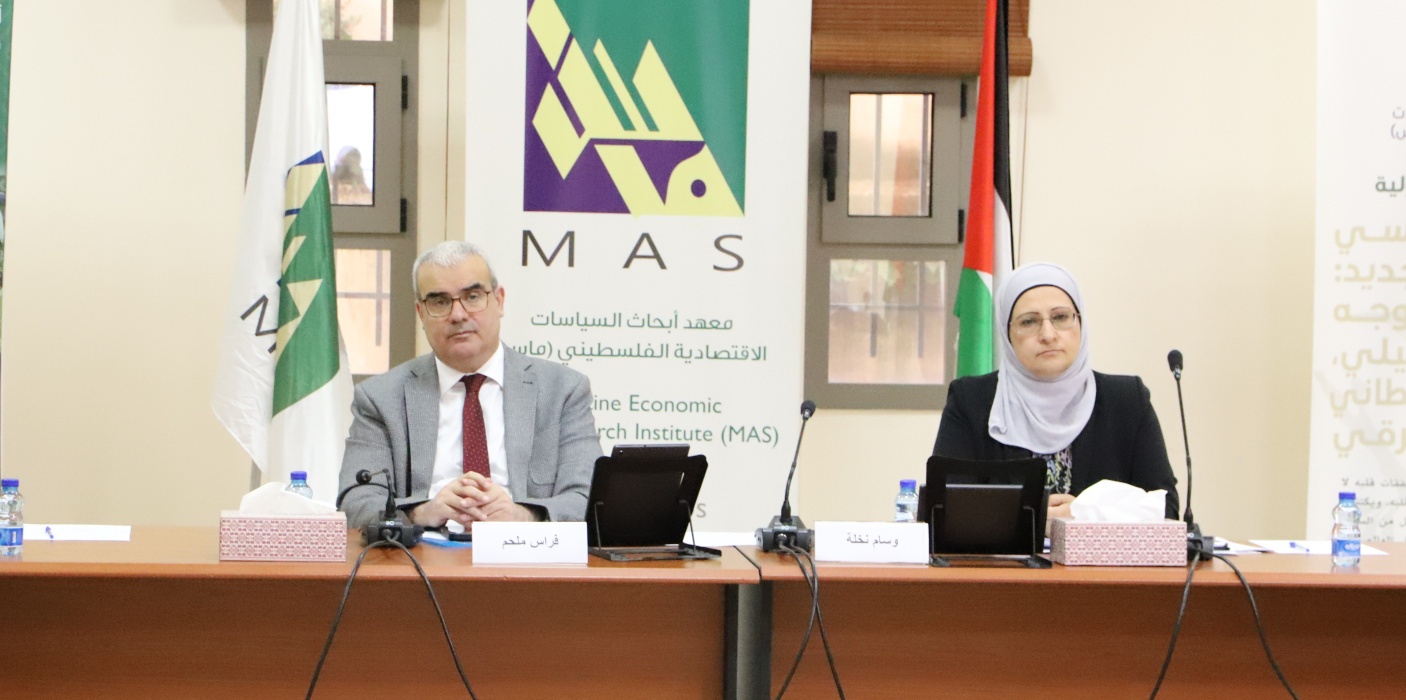
The Palestine Economic Policy Research Institute (MAS) held its fourth 2026 roundtable session, in partnership with and sponsored by the Heinrich Böll Foundation (Palestine and Jordan), to discuss “Education in Gaza Amid War: From Survival to Recovery and Renewal.”
The background paper was prepared by Dr. Adnan Aish, Lecturer at Al-Azhar University of Gaza. Two experts provided comments on the paper: Engineer Wisam Nakhleh, Director General of Buildings at the Ministry of Education and Higher Education (MoEHE), and Dr. Ammar El-Qidra, a researcher and economic expert from Gaza.
MAS’s Director General opened the session by welcoming participants and emphasizing the critical importance of the topic, given the unprecedented challenges confronting the Gazan education sector. He pointed out that the financial crisis, resulting from Israel's continued withholding of Palestinian clearance revenues, directly impacts the Palestinian government's ability to meet its obligations, especially in the education and health sectors.
Mr. Aljoscha Albrecht, Director of the Heinrich Böll Foundation Palestine and Jordan Office, expressed his appreciation for the long-standing partnership between the two institutions, which has facilitated multiple policy dialogues on development issues. He added that MAS consistently focuses on critical issues affecting the Palestinian population. Albrecht expressed his organization's pride in supporting this particular roundtable due to its focus on education in the Gaza Strip (GS), which he described as a pressing humanitarian concern requiring serious attention.
In his presentation, Dr. Aish stated that Gaza’s education sector experienced unprecedented destruction between 2023 and 2026. More than 95% of schools were fully or partially damaged, while many have been converted into shelter centers to house internally displaced people. Higher education institutions were also directly affected, with universities and vocational training centers sustaining sizable damage that disrupted teaching, learning, and scientific research. Over 625,000 children and 88,000 university students were affected by the disruption of education, and more than 19,000 students and up to 1,000 teachers and academic directors were killed. Further, he showed that this catastrophe resulted in extensive learning loss.
The researcher highlighted that, despite the scale of destruction inflicted on Gaza’s education sector, educational operations never came to a complete halt. A range of adaptation strategies emerged to help sustain educational continuity. These responses included the use of online and distance learning, establishing Temporary Learning Spaces (TLSs) inside shelter centers, launching communal initiatives for informal education, and leveraging international aid partnerships and academic resilience measures, such as study scholarships and access to digital academic resources.
The paper presents an evaluation of the survival and resilience phase of education in Gaza, showing that despite devastating levels of destruction, the sector maintained a minimal degree of learning continuity through adaptive strategies. Nonetheless, resilience remains fragile due to the widespread destruction of educational infrastructure, extensive learning loss, weakened digital infrastructure, and limited accessibility, alongside ongoing internal displacement, financial constraints, and continued bombardment and instability. Therefore, the paper calls for rebuilding a more resilient and sustainable education sector through digital transformation, blended education, enhanced vocational and technical education, and the effective use of Palestinian diaspora expertise.
The researcher also outlined three potential scenarios for Gaza’s future, each grounded in current realities and shaped by changes in security conditions and available funding over time. They range from continued crisis management to gradual recovery, and ultimately to holistic reconstruction and systematic transformation.
Dr. Aish concluded by presenting a recovery and renewal roadmap consisting of three interlocking phases: First Phase: Focuses on immediate priorities, including ensuring education continuity, addressing learning loss, and solidifying psychosocial support. Second Phase: Identifies medium-term priorities, including rebuilding educational infrastructure, advancing digital and vocational education, and expanding academic partnerships. Third Phase: Lays out long-term priorities aimed at establishing a more resilient education system by institutionalizing blended learning, enhancing universities' developmental roles, and building sustainable development partnerships.
In her intervention, Engineer Wisam Nakhleh affirmed that the education sector in the Gaza Strip has suffered massive damage and has been deliberately targeted by Israeli forces. She noted that targeting and killing several university presidents in the Strip demonstrates the obvious obstruction of academic institutions and carries far-reaching implications for human development in Gaza.
She added that MoEHE efforts are ongoing, stressing that academic curricula remain unified between the West Bank and the Gaza Strip. The Strip had 562 schools before the aggression, and rebuilding the education sector, as estimated by the MoEHE, will require up to 4 billion dollars. Given the current conditions, she stressed the urgent need to further boost and expand distance learning.
Dr. Ammar El-Qidra underlined that education is a primary priority in the recovery process and plays a central role in the post-war reconstruction agenda. He underscored the importance of preserving structured education to help protect an entire generation that has been deprived of schooling over the past three years. Education is a pivotal pathway for social protection, which calls for a dedicated focus on creating safe environments for children in light of the multiple traumas they have endured, he added. Returning to school is not limited to restoring educational services, but is also about providing safe spaces and environments. He underscored the vitality of involving families in recovery schemes and empowering universities, researchers, and experts during the reconstruction phase, while maintaining a focus on building an education system that is resilient to future crises.
In their interventions, participants outlined the numerous challenges facing the educational process in the Strip since October 7, 2023, requiring a gradual recovery approach that is practical, executable, and responsive to realities on the ground. They stressed that the continuation of the aggression, together with ongoing displacement and migration, further exacerbates the education sector’s challenges. They also called for the development of an education system that responds to the Gazan population’s aspirations and needs, serving as a key pillar for development and recovery in the Gaza Strip.
To download the full Background paper, follow this link.